
If you want lightweight, reliable scuba regulators for travel in 2025, consider options like the aluminum alloy First Stage regulator for strength without bulk.
The Mares SXS 62X set offers compact design and smooth airflow with durable construction.
Cressi’s AC2 piston kit and XS2/AC2 package balance reliability and ease of maintenance, while the Intense Use model excels in demanding conditions without weighing you down.
Keep exploring to discover how to match these picks perfectly to your travel diving needs.
| Image | Name | Editor's Rating | Price |
|---|---|---|---|

|
Yuecoom First Stage Scuba Diving Regulator, First Stage Dive...
|
|
|

|
Mares SXS 62X Scuba Diving Regulator Set - First (INT) and.....
|
|
|
|
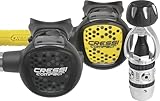
Cressi AC2 / Compact + Octopus Compact Complete Regulator...
|
|
|

|
CRESSI AC2/XS2 Regulator & XS2 Octo Package
|
|
|

|
Cressi AC2 / Compact, Silver, INT
|
|
First Stage Scuba Diving Regulator, Aluminium Alloy
- Safety Ensured: With a surplus pressure...
- Precision Gas Control: Experience stable...
- Reliable Construction: Crafted from...
The First Stage Scuba Diving Regulator features a durable aluminum alloy construction that balances strength with lightweight design. Its Yoke 1st Stage reduces breathing resistance, allowing for smooth and comfortable airflow. This regulator ensures precise gas control for reliable performance in various underwater environments.
Equipped with a surplus pressure gauge and pressure reducing valve, it enhances diver safety by maintaining stable pressure levels. The regulator adapts well to diverse conditions, from deep ocean dives to tranquil lakes, supporting long explorations with steady breathing ease. Proper care is advised to maintain its performance, especially in saltwater.
Best for: Divers seeking a lightweight yet durable first stage regulator with precise control and safety features for multiple diving conditions.
Pros:
- Lightweight yet strong aluminum alloy build for durability
- Stable gas control with a Yoke 1st Stage design
- Safety-enhanced with surplus pressure gauge and pressure reducing valve
- Suitable for various underwater environments
Cons:
- May need regular maintenance in harsh saltwater
- Yoke 1st Stage might not fit all tank valves
- Aluminum alloy could be more prone to corrosion if not well cared for
Mares SXS 62X Scuba Diving Regulator Set – First and Second Stage
- COMPACT DESIGN - The SXS 62X Scuba...
- 62X FIRST STAGE - The 62X INT first...
- DYNAMIC FLOW CONTROL - Equipped with...
The Mares SXS 62X Scuba Diving Regulator Set features a compact and lightweight second stage designed for easy travel. Its durable first stage includes a chrome pearl finish and Auto-Sealing Technology to keep water out when not in use. This ensures reliable performance in various diving conditions.
The regulator set provides consistent airflow through Dynamic Flow Control and pre-oriented ports. The second stage’s Vortex Assisted Design and curved bypass tube maximize airflow, while the lateral exhaust tube improves visibility underwater. The Superflex hose is ideal for cold water diving and can be switched for added comfort.
Best for: Travel divers and minimalist scuba enthusiasts seeking a lightweight, compact regulator set with enhanced airflow and cold water compatibility.
Pros:
- Compact and lightweight second stage for easy travel and packing
- Auto-Sealing Technology prevents water entry in the first stage
- Vortex Assisted Design and Dynamic Flow Control ensure steady airflow
- Superflex hose suitable for cold water and adjustable for comfort
Cons:
- May be less popular based on best sellers rank (#627,806 in Sports & Outdoors)
- Limited customer ratings might not reflect a wide range of user experiences
- Could be less suitable for divers preferring traditional or heavier-duty setups
Cressi Scuba Diving Regulator Kit (AC2 Piston 1st Stage, Compact 2nd Stage, Octopus Compact)
- This regulator is made up of the new 2nd...
- Octopus XS Compact uses the same casing...
- Simple piston 1st stage, a "work mule...
The Cressi Scuba Diving Regulator Kit features a reliable AC2 piston 1st stage paired with a compact 2nd stage and an Octopus Compact. Its design uses durable plastic and stainless steel, ensuring solid performance and ease of maintenance. The simple piston mechanism and elastomer-covered 2nd stage contribute to smooth breathing underwater.
This lightweight kit delivers excellent airflow through four low-pressure and one high-pressure outlet, accommodating essential scuba equipment connections. Its compact form and minimal components make it well-suited for travel and rental use. Crafted in Italy, it balances functionality with user-friendly design.
Best for: Beginner divers, diving schools, and rental operations seeking a lightweight and dependable scuba diving regulator kit.
Pros:
- Lightweight and easy to handle for travel and daily use
- Durable build combining plastic and stainless steel components
- Simple piston 1st stage allows straightforward maintenance
- Four low-pressure outlets provide versatile hose connections
Cons:
- May be less suited for advanced or technical diving requirements
- Limited to one high-pressure outlet for additional equipment
- Some users might prefer features found in more advanced regulator kits
Cressi XS2/AC2 Regulator and XS Octopus Package
- INCLUDED - 1'st Stage, 2'nd Stage...
- OPTIMAL PERFORMANCE - Experience...
- CUSTOMIZABLE COMFORT - Easily adjust the...
The Cressi XS2/AC2 Regulator and XS Octopus Package is designed for reliable performance in diverse diving conditions. Its non-balanced flow-by piston 1st stage ensures consistent air delivery at all depths. The 2nd stage features a Dive/Pre-Dive Venturi Adjustment for a personalized breathing experience.
Built with marine-grade chromed brass and corrosion-resistant polymers, this set offers durability and resistance to harsh environments. The flexible hose routing and 33-inch octopus hose make it adaptable to various setups. Weighing just under a kilo, it meets the EN250/2000 certification standards for safety and reliability.
Best for: New divers seeking a dependable and customizable regulator package suitable for travel and multiple diving scenarios.
Pros:
- Steady air delivery with non-balanced flow-by piston 1st stage
- Adjustable breathing effort via Dive/Pre-Dive Venturi on 2nd stage
- Durable materials resist corrosion and wear
- Flexible hose routing enhances setup adaptability
Cons:
- Non-balanced 1st stage may perform less smoothly in extreme conditions
- Slightly heavier than some ultra-light regulator options
- Limited user ratings might affect confidence in long-term use
Cressi Intense Use Scuba Diving Regulator (AC2/Compact)
- Ideal scuba diving regulator for...
- A heavy-duty piston 1st stage...
- Conical filter with large filtering...
The Cressi Intense Use AC2/Compact scuba regulator offers a lightweight and durable design, perfect for demanding diving conditions. Its heavy-duty piston 1st stage includes four low-pressure ports and one high-pressure port, ensuring reliable performance. The compact single-hull 2nd stage provides smooth airflow with minimal dependence on the Venturi effect, enhancing breathing comfort underwater.
Manufactured in Italy, this regulator features a large-capacity conical filter and allows easy low-pressure adjustments. It is built to withstand intense use, making it a practical choice for both everyday diving and travel. The design balances robustness with portability, appealing to divers who need dependable gear without bulk.
Best for: Beginners and frequent travelers seeking a reliable and durable scuba diving regulator.
Pros:
- Lightweight and compact for easy handling and travel.
- Heavy-duty piston 1st stage with versatile port options.
- Smooth and abundant airflow with minimal Venturi reliance.
- Large-capacity conical filter for reliable performance.
Cons:
- Warranty coverage may be shorter than some premium models.
- Lacks advanced features found in high-end regulators.
- Single-hull 2nd stage might offer less noise reduction than dual-hull designs.
Factors to Consider When Choosing a Scuba Regulator for Travel
When choosing a scuba regulator for travel, you’ll want to focus on weight and portability to keep your gear manageable. Durability and breathing performance consistency are essential for reliable use in different conditions.
Also, consider how easy it is to maintain and whether it performs well across various environments.
Weight and Portability
Although choosing a scuba regulator might seem straightforward, paying close attention to weight and portability can make a huge difference during your travels. Opt for a lightweight regulator—some weigh as little as 2.5 pounds—so you can cut down on luggage weight and move easily. Look for compact designs with smaller second stages that fit comfortably in your dive bag or carry-on.
Prioritize models made from lightweight materials like technopolymer or aluminum alloy; they keep the weight low without compromising performance. Features such as folding hoses or streamlined shapes boost portability, making packing and handling simpler. Travel-friendly regulators balance size, weight, and functionality, ensuring you get reliable gear that’s easy to transport wherever you dive next.
Durability and Materials
Because travel exposes your scuba gear to tough conditions, you should prioritize durability and materials when choosing a regulator. Look for marine-grade chromed brass or high-quality aluminum alloy, as these resist corrosion and stand up to harsh underwater environments.
If you want to keep your luggage light, consider technopolymer options—they’re durable yet considerably reduce weight. A regulator with an abrasion-resistant finish, like chrome pearl, helps maintain an elegant look despite frequent handling and transport.
Choosing a model with fewer components also means less maintenance and easier packing, perfect for frequent travelers. Finally, make sure your regulator is certified for consistent performance across various conditions, ensuring it’ll hold up no matter where your dive adventures take you.
Breathing Performance Consistency
To enjoy every dive on your travels, you need a regulator that delivers consistent breathing performance regardless of depth or conditions. Look for models featuring Dynamic Flow Control, which guarantees steady airflow no matter how deep you go. Adjustable Venturi systems let you tailor the breathing resistance to your preference, providing comfort in varying dive environments.
High-quality materials also play an essential role, maintaining reliable function dive after dive. Additionally, regulators with sufficient low-pressure and high-pressure ports improve hose routing, reducing drag and making breathing easier. By focusing on these features, you’ll have a regulator that performs smoothly and reliably, letting you concentrate on exploring underwater without worrying about your air supply or breathing effort.
Maintenance and Ease
When you’re traveling with scuba gear, choosing a regulator that’s easy to maintain can save you time and headaches. Look for models with minimal components, as they usually require less upkeep and are simpler to service. Prioritize regulators made from durable materials like high-quality plastics and stainless steel to withstand travel wear and last longer.
Opt for designs featuring simple piston mechanisms and accessible adjustment points, allowing quick fixes when needed. Consider regulators with self-lubricating parts or built-in filters that prevent particle infiltration, reducing how often you have to maintain them. Finally, check user reviews to pinpoint models known for reliability and low maintenance demands, ensuring your diving trip stays hassle-free and enjoyable.
Versatility in Conditions
Although travel diving takes you to varied environments, your scuba regulator should perform reliably whether you’re exploring ocean depths, freshwater lakes, or underwater caves. Choose a regulator built with durable materials like aluminum alloy or marine-grade chromed brass to handle harsh conditions without compromising performance.
Look for models featuring advanced tech such as Auto-Sealing Technology and Dynamic Flow Control, which maintain consistent airflow and prevent water entry even in challenging spots. A regulator with multiple low- and high-pressure ports lets you customize hose routing, adapting to different setups effortlessly.
Since you’re traveling, prioritize lightweight, compact designs that reduce gear bulk but don’t sacrifice functionality. This versatility guarantees your regulator stays dependable, no matter where your underwater adventures take you.
Frequently Asked Questions
How Do I Maintain My Scuba Regulator During Travel?
You should flush your regulator with fresh water after every dive, let it dry completely, and store it in a protective case. Avoid crushing hoses, and have it serviced regularly. This will guarantee it stays reliable and ready for your next adventure.
Can Scuba Regulators Be Used in Both Saltwater and Freshwater?
Yes, you can use scuba regulators in both saltwater and freshwater. Just remember to rinse them thoroughly with fresh water after each dive to prevent corrosion and keep your equipment working smoothly wherever you dive.
Regular maintenance is key to extending the life of your regulators. This care ensures reliable performance regardless of the water type. Always follow manufacturer guidelines for cleaning and storage.
What Is the Average Lifespan of a Travel Scuba Regulator?
You can expect a travel scuba regulator to last about 5 to 10 years with proper care. Regular servicing and rinsing after dives will keep it reliable and extend its lifespan considerably.
Taking good care of your regulator is essential to maintain its performance. Proper storage and avoiding exposure to harsh conditions also help in prolonging its life.
Always follow the manufacturer’s guidelines for maintenance and servicing intervals. This will ensure your regulator remains safe and functional for many years.
Are There Travel Restrictions for Carrying Scuba Regulators on Flights?
You’d think carrying scuba regulators on flights is as tricky as defusing a bomb! Actually, you can bring them, but they must be empty and comply with airline rules.
Always check specific airline policies before flying.
How Do Temperature Changes Affect Scuba Regulator Performance?
Temperature changes can cause your scuba regulator to freeze or malfunction, especially in cold water.
You’ll want a regulator designed for cold conditions to guarantee consistent airflow and avoid free-flow or performance issues during your dive.
Conclusion
So, ready to lug around a brick underwater? Didn’t think so.
Pick a lightweight, reliable scuba regulator from our list, and you’ll actually enjoy your plunge instead of wrestling gear that feels like scuba scuba scuba.
Travel light, breathe easy, and impress everyone by not turning into a flailing octopus on your next adventure.
Because, honestly, your regulator should be the least of your worries—unless you’re into underwater workout sessions!

I am a passionate explorer of the deep sea, endlessly fascinated by the mysteries that lie beneath the ocean’s surface. From the graceful glide of a manta ray to the powerful presence of a great white shark, I find inspiration in every creature that calls the sea its home. My love for marine life began at an early age and has grown into a lifelong mission to study, understand, and share the wonders of our blue planet. Through Planet Shark Divers, I combine my enthusiasm for sharks and other sea animals with a dedication to education and conservation. Each article is crafted to unravel myths, reveal fascinating facts, and inspire respect for the extraordinary life forms that thrive in the depths. Whether it’s the biology of a hammerhead or the mystery of the deep abyss, my goal is to bring the ocean closer to everyone’s heart and mind.